 Image 1 of 5
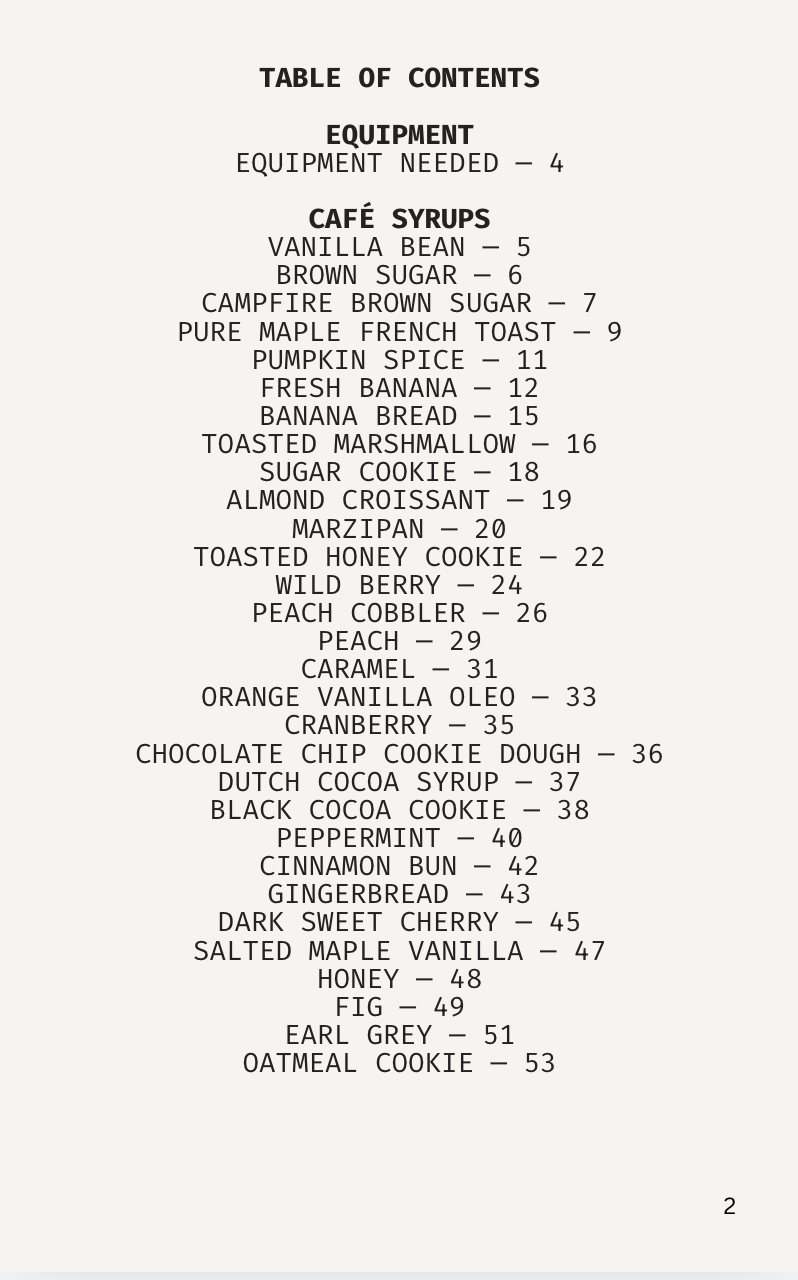 Image 2 of 5
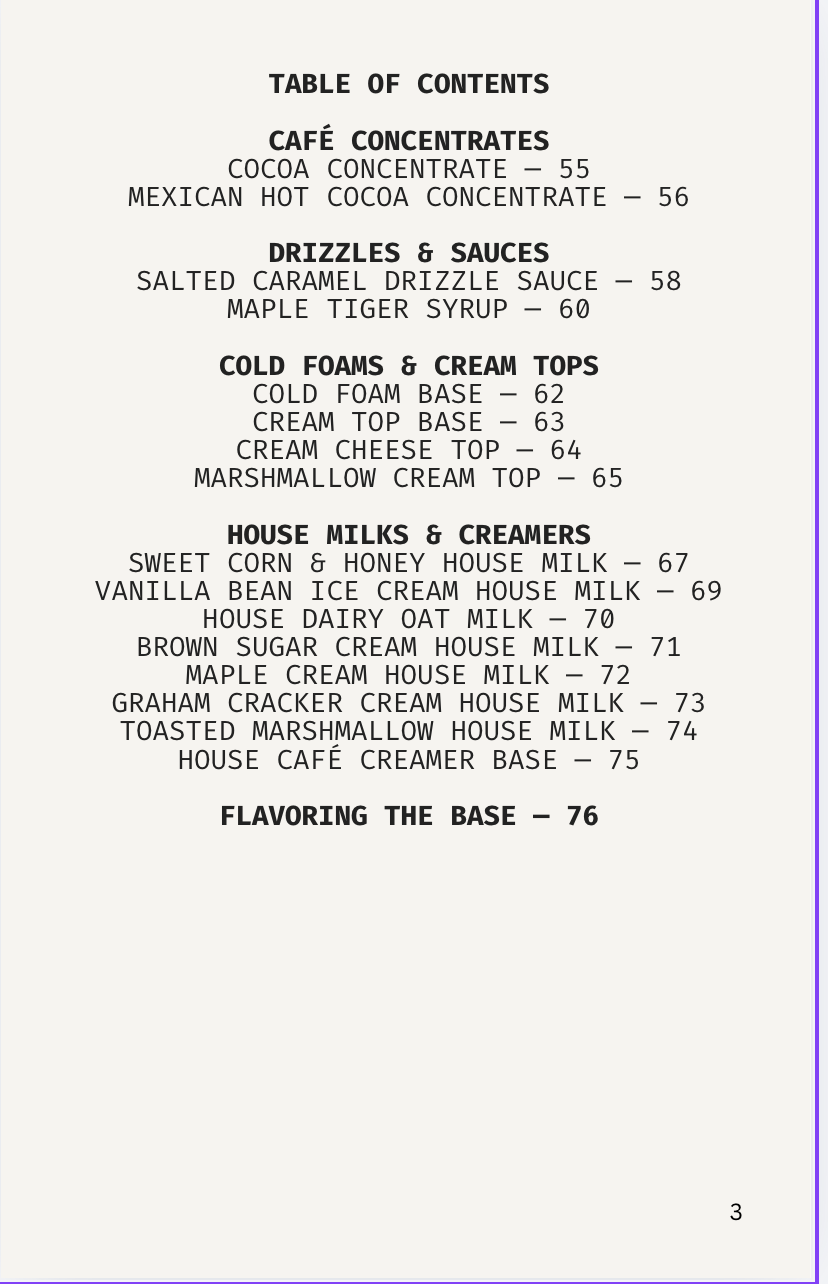 Image 3 of 5
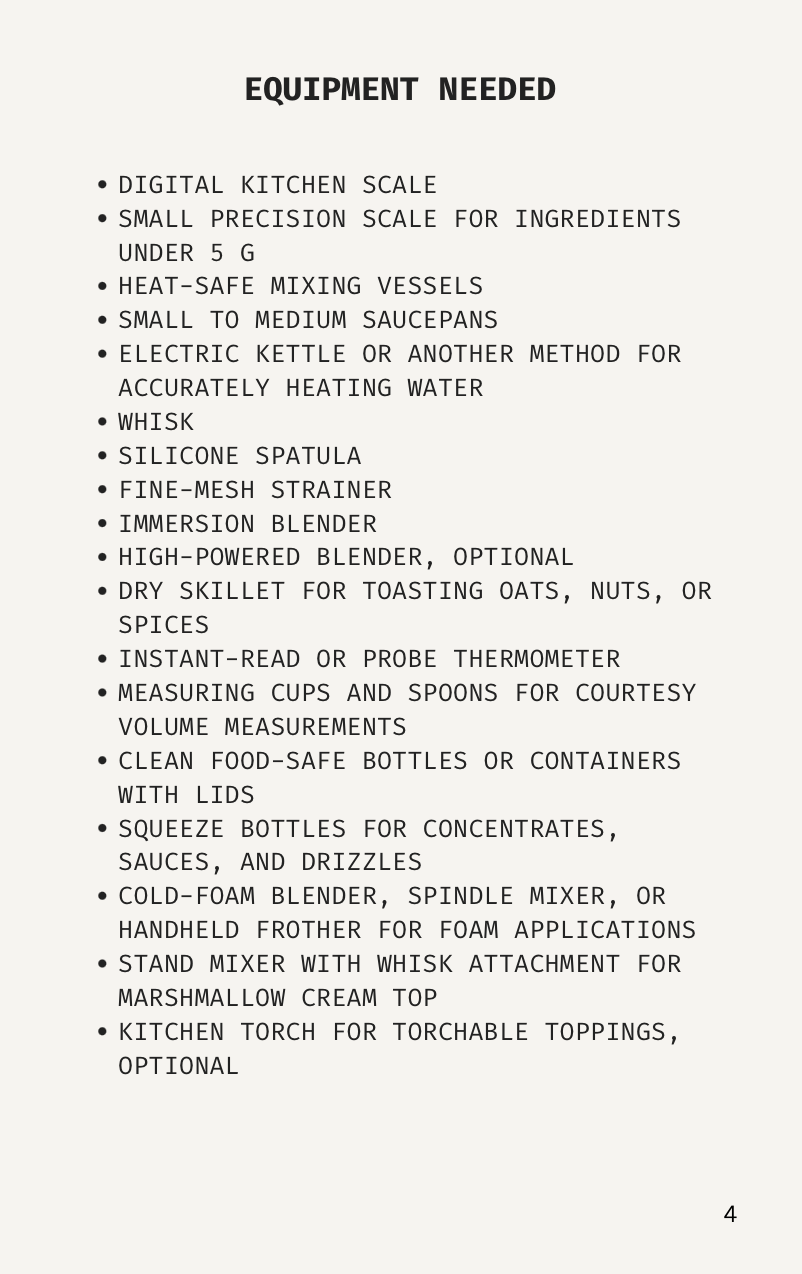 Image 4 of 5
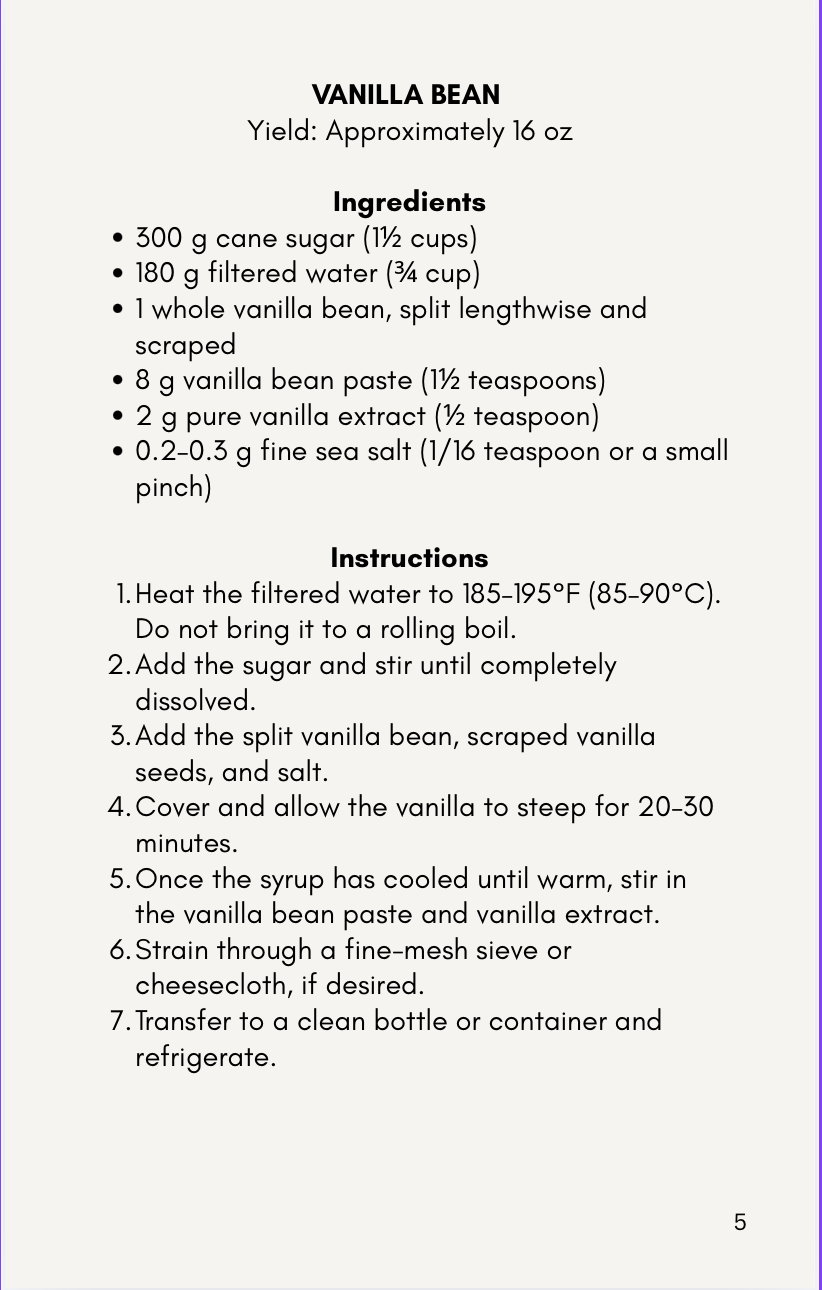 Image 5 of 5
Fall + Winter Cafe Syrups 2026
46 professional café formulas. This is NOT a Bakeshop Collection Recipe. This is individual in the proprietary/specialty category of the Market.
A seasonal café recipe collection built for home baristas, coffee shops, café owners, and anyone interested in developing more intentional house-made beverage components.
This is a recipe book, not a café operations manual or food-safety certification course. Each recipe gives you the formula, method, and recipe-specific notes needed to prepare it. I also share free café-development education and my Café Syrup Development Masterclass on TikTok (Coming soon to YouTube too) for anyone who wants to go deeper into the formulation, science, troubleshooting, and development behind this style of recipe.
WHAT’S INCLUDED
30 individual café syrup recipes
2 café concentrates
2 drizzles + sauces
4 cold foams + cream tops
8 house milks + creamer bases
46 total formulas.
The collection includes everything from Vanilla Bean, Brown Sugar, Toasted Marshmallow, Almond Croissant, Dark Sweet Cherry and Wild Berry to Cocoa Concentrates, Maple Tiger Syrup, cream tops, Sweet Corn + Honey House Milk, Maple Cream House Milk, and more.
Several recipes from this collection have already been shared by me for free. If you’re unsure whether this book is right for you, I actually encourage you to try one of my free café recipes first. They’re a good preview of my formulation style and the type of recipes included here.
BEFORE YOU PURCHASE
These are my developed formulas and starting points, not rules for how every café beverage should taste.
Beverage preferences vary tremendously. Your preferred sweetness, flavor intensity, espresso, matcha, milk, ice, serving size, temperature, and syrup dose can all change how a finished beverage tastes.
You are welcome to adjust these formulas for your own preferences and application.
If you want substantially more vanilla, use more vanilla. If you prefer a house milk sweeter, adjust it. If you want to take one of the base formulas and develop a completely different flavor from it, you can.
My free Café Syrup Development Masterclass is intended to help you understand how to make those decisions intentionally, rather than treating these formulas as something you cannot touch.
HOW TO USE THE RECIPES
I develop and physically test my formulas by weight using metric measurements.
Metric weights are the primary formula and are what I recommend using, particularly for café production and repeatability.
Volume measurements are also included for accessibility, but they are conversions. I do not develop or test the formulas by volume. Minor differences are therefore possible when using cups, tablespoons, and teaspoons.
For the most consistent result, use the gram measurements and a digital scale. A small precision scale is also useful for ingredients used in very small amounts, such as salt, citric acid, spices, extracts, and concentrated flavorings.
About my kettle method
If a recipe does not specifically require stovetop cooking, reduction, caramelization, or another saucepan method, I often prepare my hot water with an electric kettle.
You do not need the same kettle I use.
If the recipe calls for water around 190–200°F, you can heat that water however you prefer. An electric kettle, temperature-controlled kettle, or saucepan is fine. The important part is reaching the appropriate temperature and following the method instead of owning a specific appliance.
When I'm using hot water just to dissolve sugar, I am not trying to boil or reduce the syrup.
Putting the same ingredients into a saucepan and boiling them for an extended period can evaporate additional water and leave you with a more concentrated and potentially much thicker finished syrup.
If the recipe actually requires cooking, the instructions will tell you.
STEEP + INFUSION TIMES
Steep times listed in these recipes should generally be understood as the minimum developed time for that formula, not necessarily the maximum amount of time an ingredient can remain in the syrup.
Depending on the recipe and the flavor intensity you prefer, you may choose to continue the infusion longer. For example, you may let vanilla bean continue steeping as the syrup cools or keep the bean in the finished bottle. Whole cinnamon sticks can be left to infuse longer for a stronger spice profile. Fig and certain other whole or dried ingredients can also continue infusing beyond the initial preparation time when appropriate.
Some cafés intentionally use much longer house infusions, including refrigerated overnight or 24–48 hour infusions. You can absolutely develop these recipes that way if it produces the flavor profile you prefer.
Longer is not automatically better, and shorter is not automatically less professional. Different ingredients extract differently. Tea, delicate spices, citrus peel, whole vanilla, dried fruit, and cinnamon should not all be treated as though they have the same ideal extraction window. With some ingredients, additional time builds useful flavor; with others, extended extraction can eventually introduce bitterness, astringency, excessive spice, or a different flavor balance.
The times in this book give you the developed starting point I used for the recipe. From there, taste and adjust for your application. If you choose a longer house infusion for café production, document the time, temperature, ingredient ratio, and finished result so it can be reproduced consistently.
For perishable ingredients or extended infusions, use appropriate refrigerated storage rather than interpreting a longer steep as permission to leave the product at room temperature.
Want a stronger infusion?
You do not necessarily need to increase the ingredient first. Where appropriate, try extending the infusion time, taste at intervals, and document the point you prefer.
About “flavoring”
Throughout the book, I sometimes use the word flavoring broadly.
Depending on the formula and what you have available, this may be an extract, emulsion, concentrated flavor, or another appropriate beverage-compatible flavoring.
Brands and products vary significantly in strength.
Because of that, when a recipe gives you a range, start low.
You can always add more.
Two grams of one company's flavoring may not produce the same intensity as two grams of another company's product. Manufacturer usage recommendations should also be considered, particularly with highly concentrated products.
When developing for a café, I recommend documenting the brand and exact product you used once you've finalized your version. That makes the formula much easier for you or your staff to reproduce.
And remember to evaluate the flavor in its intended beverage. A syrup that tastes extremely strong by itself may taste completely different once diluted with milk, espresso, matcha, ice, or other drink components.
THESE SYRUPS MAY NOT LOOK LIKE A STANDARD SIMPLE SYRUP
Many of my café syrups are intentionally more concentrated than a traditional 1:1 simple syrup.
That means some will naturally have more body, particularly when refrigerated.
The collection also uses ingredients such as real fruit, cocoa, brown sugar, honey, maple syrup, fruit extractions, spices, and other ingredients that can affect the final texture.
A real-fruit syrup may have natural sediment.
A syrup may become noticeably thicker after refrigeration.
Fruit containing pectin may develop additional body after sitting.
A drizzle is intentionally going to behave differently from a beverage syrup.
This is why I strongly recommend allowing a finished syrup to cool completely before making major consistency adjustments.
If a syrup needs adjustment for your particular ingredients or service application, make small, measured changes and keep notes.
FRUIT + NATURAL INGREDIENT VARIATION
Real fruit is not perfectly standardized.
Ripeness, variety, brand, fresh versus frozen fruit, water content, straining pressure, blending, cooking time, and natural pectin can all affect your extraction and finished syrup.
Your fruit extraction yield may therefore differ somewhat from mine.
Follow any specified finished extraction weights in the individual formula rather than assuming every gram of liquid you extract needs to be added to the finished syrup.
Also avoid aggressively pressing fruit solids through a strainer simply to increase yield unless that texture is what you want. More recovered material can also mean more pulp, pectin, seeds, or fine solids in the finished syrup.
These are the kinds of variables I discuss in much greater depth in the free masterclass.
FOR CAFÉ USE
If you're preparing these recipes for a business, I recommend establishing your own standardized version after testing the formula with your ingredients, equipment, and beverages.
Record ingredient brands where relevant, batch weights, finished yields, service dose, storage procedures, and any adjustments you make.
I also recommend actually testing your finalized syrup in the beverages you intend to sell rather than evaluating it only from the bottle.
Your espresso, milk, matcha, serving size, ice, and other components matter.
A formula I enjoy at 25–30 g per drink may not be your preferred dose. Develop the finished beverage around your menu and customer.
STORAGE + FOOD SAFETY
These recipes are designed as house-made café components, not commercially validated shelf-stable bottled products.
Follow appropriate food-handling and refrigeration practices for the ingredients you're using and the requirements applicable to your business/location.
Do not assume that sugar concentration, acidity, citric acid, a Brix reading, or hot filling alone establishes commercial shelf stability.
If you intend to manufacture and sell bottled syrups as shelf-stable retail products, that is a different level of production and may require validated processes, testing, regulatory compliance, and qualified food-safety guidance.
STORAGE + SHELF LIFE
These recipes include a wide range of ingredients and preparation methods, so I do not provide one shelf-life guarantee for the entire collection.
Shelf life can vary based on the formula, sugar concentration, water activity, acidity/pH, whether the recipe contains fresh fruit or dairy, preparation and sanitation practices, storage temperature, container, handling during service, and other variables specific to your kitchen or café.
For home use, prepare reasonable batch sizes, store products appropriately in clean, covered containers, refrigerate recipes requiring refrigeration, and use good food-safety judgment. Discard anything showing signs of spoilage or an unexpected change in appearance, aroma, texture, or fermentation.
For commercial café use, establish storage and discard procedures appropriate to the individual formula and your operation, and follow your local food-safety requirements. A recipe being high in sugar or acidic does not, by itself, mean that it is shelf stable.
The syrups, house milks, cream tops, fruit preparations, and other components in this collection should not all be assigned the same shelf life. I cannot responsibly guarantee an exact number of days for a product made outside of my own controlled preparation and storage conditions.
These formulas are intended as house-made café components and have not been presented as validated shelf-stable retail products. If you intend to bottle and sell a product as shelf stable, additional testing, process validation, and regulatory requirements may apply.
FREE CAFÉ SYRUP DEVELOPMENT MASTERCLASS
The recipe book gives you the formulas.
The masterclass will be there to teach you how I think about them.
I'm releasing my Café Syrup Development Masterclass publicly and for free on TikTok (Working on Youtube for those off TikTok) rather than putting the education behind this purchase.
We'll be covering topics including syrup concentration, sugar systems, Brix and refractometers, extracts and flavorings, real-fruit development, extraction and infusion methods, viscosity, crystallization, troubleshooting, testing formulas, beverage development, scaling, café production, and more.
You can use that education with this collection, my free recipes, other recipes you already use, or your own café development.
You do not need to purchase this book to access the masterclass.
NEED HELP?
Please contact me through the Contact page/contact form on my website if you purchase the collection and need help understanding or troubleshooting one of the recipes.
If your fruit extraction yielded differently, your syrup became thicker than expected, you're unsure about a flavoring adjustment, or something isn't behaving the way you expected, send me the details of what you made and what happened.
For troubleshooting, it is especially helpful to include the exact formula you followed, ingredient brands/substitutions, any changes you made, your method, and photos when relevant.
Purchasing the recipe book does not include unlimited private recipe development or custom formula creation, but I do want you to contact me with reasonable questions or troubleshooting related to the recipes you've purchased.
This collection represents my approach to café recipe development.
It isn't presented as the only correct way to make a syrup, and I don't expect every person to have the same sweetness or flavor preferences that I do.
I want to give you a professionally developed place to start and enough information and free education to understand what you're making, adjust it intelligently, and eventually use that knowledge in your own development.
46 professional café formulas. This is NOT a Bakeshop Collection Recipe. This is individual in the proprietary/specialty category of the Market.
A seasonal café recipe collection built for home baristas, coffee shops, café owners, and anyone interested in developing more intentional house-made beverage components.
This is a recipe book, not a café operations manual or food-safety certification course. Each recipe gives you the formula, method, and recipe-specific notes needed to prepare it. I also share free café-development education and my Café Syrup Development Masterclass on TikTok (Coming soon to YouTube too) for anyone who wants to go deeper into the formulation, science, troubleshooting, and development behind this style of recipe.
WHAT’S INCLUDED
30 individual café syrup recipes
2 café concentrates
2 drizzles + sauces
4 cold foams + cream tops
8 house milks + creamer bases
46 total formulas.
The collection includes everything from Vanilla Bean, Brown Sugar, Toasted Marshmallow, Almond Croissant, Dark Sweet Cherry and Wild Berry to Cocoa Concentrates, Maple Tiger Syrup, cream tops, Sweet Corn + Honey House Milk, Maple Cream House Milk, and more.
Several recipes from this collection have already been shared by me for free. If you’re unsure whether this book is right for you, I actually encourage you to try one of my free café recipes first. They’re a good preview of my formulation style and the type of recipes included here.
BEFORE YOU PURCHASE
These are my developed formulas and starting points, not rules for how every café beverage should taste.
Beverage preferences vary tremendously. Your preferred sweetness, flavor intensity, espresso, matcha, milk, ice, serving size, temperature, and syrup dose can all change how a finished beverage tastes.
You are welcome to adjust these formulas for your own preferences and application.
If you want substantially more vanilla, use more vanilla. If you prefer a house milk sweeter, adjust it. If you want to take one of the base formulas and develop a completely different flavor from it, you can.
My free Café Syrup Development Masterclass is intended to help you understand how to make those decisions intentionally, rather than treating these formulas as something you cannot touch.
HOW TO USE THE RECIPES
I develop and physically test my formulas by weight using metric measurements.
Metric weights are the primary formula and are what I recommend using, particularly for café production and repeatability.
Volume measurements are also included for accessibility, but they are conversions. I do not develop or test the formulas by volume. Minor differences are therefore possible when using cups, tablespoons, and teaspoons.
For the most consistent result, use the gram measurements and a digital scale. A small precision scale is also useful for ingredients used in very small amounts, such as salt, citric acid, spices, extracts, and concentrated flavorings.
About my kettle method
If a recipe does not specifically require stovetop cooking, reduction, caramelization, or another saucepan method, I often prepare my hot water with an electric kettle.
You do not need the same kettle I use.
If the recipe calls for water around 190–200°F, you can heat that water however you prefer. An electric kettle, temperature-controlled kettle, or saucepan is fine. The important part is reaching the appropriate temperature and following the method instead of owning a specific appliance.
When I'm using hot water just to dissolve sugar, I am not trying to boil or reduce the syrup.
Putting the same ingredients into a saucepan and boiling them for an extended period can evaporate additional water and leave you with a more concentrated and potentially much thicker finished syrup.
If the recipe actually requires cooking, the instructions will tell you.
STEEP + INFUSION TIMES
Steep times listed in these recipes should generally be understood as the minimum developed time for that formula, not necessarily the maximum amount of time an ingredient can remain in the syrup.
Depending on the recipe and the flavor intensity you prefer, you may choose to continue the infusion longer. For example, you may let vanilla bean continue steeping as the syrup cools or keep the bean in the finished bottle. Whole cinnamon sticks can be left to infuse longer for a stronger spice profile. Fig and certain other whole or dried ingredients can also continue infusing beyond the initial preparation time when appropriate.
Some cafés intentionally use much longer house infusions, including refrigerated overnight or 24–48 hour infusions. You can absolutely develop these recipes that way if it produces the flavor profile you prefer.
Longer is not automatically better, and shorter is not automatically less professional. Different ingredients extract differently. Tea, delicate spices, citrus peel, whole vanilla, dried fruit, and cinnamon should not all be treated as though they have the same ideal extraction window. With some ingredients, additional time builds useful flavor; with others, extended extraction can eventually introduce bitterness, astringency, excessive spice, or a different flavor balance.
The times in this book give you the developed starting point I used for the recipe. From there, taste and adjust for your application. If you choose a longer house infusion for café production, document the time, temperature, ingredient ratio, and finished result so it can be reproduced consistently.
For perishable ingredients or extended infusions, use appropriate refrigerated storage rather than interpreting a longer steep as permission to leave the product at room temperature.
Want a stronger infusion?
You do not necessarily need to increase the ingredient first. Where appropriate, try extending the infusion time, taste at intervals, and document the point you prefer.
About “flavoring”
Throughout the book, I sometimes use the word flavoring broadly.
Depending on the formula and what you have available, this may be an extract, emulsion, concentrated flavor, or another appropriate beverage-compatible flavoring.
Brands and products vary significantly in strength.
Because of that, when a recipe gives you a range, start low.
You can always add more.
Two grams of one company's flavoring may not produce the same intensity as two grams of another company's product. Manufacturer usage recommendations should also be considered, particularly with highly concentrated products.
When developing for a café, I recommend documenting the brand and exact product you used once you've finalized your version. That makes the formula much easier for you or your staff to reproduce.
And remember to evaluate the flavor in its intended beverage. A syrup that tastes extremely strong by itself may taste completely different once diluted with milk, espresso, matcha, ice, or other drink components.
THESE SYRUPS MAY NOT LOOK LIKE A STANDARD SIMPLE SYRUP
Many of my café syrups are intentionally more concentrated than a traditional 1:1 simple syrup.
That means some will naturally have more body, particularly when refrigerated.
The collection also uses ingredients such as real fruit, cocoa, brown sugar, honey, maple syrup, fruit extractions, spices, and other ingredients that can affect the final texture.
A real-fruit syrup may have natural sediment.
A syrup may become noticeably thicker after refrigeration.
Fruit containing pectin may develop additional body after sitting.
A drizzle is intentionally going to behave differently from a beverage syrup.
This is why I strongly recommend allowing a finished syrup to cool completely before making major consistency adjustments.
If a syrup needs adjustment for your particular ingredients or service application, make small, measured changes and keep notes.
FRUIT + NATURAL INGREDIENT VARIATION
Real fruit is not perfectly standardized.
Ripeness, variety, brand, fresh versus frozen fruit, water content, straining pressure, blending, cooking time, and natural pectin can all affect your extraction and finished syrup.
Your fruit extraction yield may therefore differ somewhat from mine.
Follow any specified finished extraction weights in the individual formula rather than assuming every gram of liquid you extract needs to be added to the finished syrup.
Also avoid aggressively pressing fruit solids through a strainer simply to increase yield unless that texture is what you want. More recovered material can also mean more pulp, pectin, seeds, or fine solids in the finished syrup.
These are the kinds of variables I discuss in much greater depth in the free masterclass.
FOR CAFÉ USE
If you're preparing these recipes for a business, I recommend establishing your own standardized version after testing the formula with your ingredients, equipment, and beverages.
Record ingredient brands where relevant, batch weights, finished yields, service dose, storage procedures, and any adjustments you make.
I also recommend actually testing your finalized syrup in the beverages you intend to sell rather than evaluating it only from the bottle.
Your espresso, milk, matcha, serving size, ice, and other components matter.
A formula I enjoy at 25–30 g per drink may not be your preferred dose. Develop the finished beverage around your menu and customer.
STORAGE + FOOD SAFETY
These recipes are designed as house-made café components, not commercially validated shelf-stable bottled products.
Follow appropriate food-handling and refrigeration practices for the ingredients you're using and the requirements applicable to your business/location.
Do not assume that sugar concentration, acidity, citric acid, a Brix reading, or hot filling alone establishes commercial shelf stability.
If you intend to manufacture and sell bottled syrups as shelf-stable retail products, that is a different level of production and may require validated processes, testing, regulatory compliance, and qualified food-safety guidance.
STORAGE + SHELF LIFE
These recipes include a wide range of ingredients and preparation methods, so I do not provide one shelf-life guarantee for the entire collection.
Shelf life can vary based on the formula, sugar concentration, water activity, acidity/pH, whether the recipe contains fresh fruit or dairy, preparation and sanitation practices, storage temperature, container, handling during service, and other variables specific to your kitchen or café.
For home use, prepare reasonable batch sizes, store products appropriately in clean, covered containers, refrigerate recipes requiring refrigeration, and use good food-safety judgment. Discard anything showing signs of spoilage or an unexpected change in appearance, aroma, texture, or fermentation.
For commercial café use, establish storage and discard procedures appropriate to the individual formula and your operation, and follow your local food-safety requirements. A recipe being high in sugar or acidic does not, by itself, mean that it is shelf stable.
The syrups, house milks, cream tops, fruit preparations, and other components in this collection should not all be assigned the same shelf life. I cannot responsibly guarantee an exact number of days for a product made outside of my own controlled preparation and storage conditions.
These formulas are intended as house-made café components and have not been presented as validated shelf-stable retail products. If you intend to bottle and sell a product as shelf stable, additional testing, process validation, and regulatory requirements may apply.
FREE CAFÉ SYRUP DEVELOPMENT MASTERCLASS
The recipe book gives you the formulas.
The masterclass will be there to teach you how I think about them.
I'm releasing my Café Syrup Development Masterclass publicly and for free on TikTok (Working on Youtube for those off TikTok) rather than putting the education behind this purchase.
We'll be covering topics including syrup concentration, sugar systems, Brix and refractometers, extracts and flavorings, real-fruit development, extraction and infusion methods, viscosity, crystallization, troubleshooting, testing formulas, beverage development, scaling, café production, and more.
You can use that education with this collection, my free recipes, other recipes you already use, or your own café development.
You do not need to purchase this book to access the masterclass.
NEED HELP?
Please contact me through the Contact page/contact form on my website if you purchase the collection and need help understanding or troubleshooting one of the recipes.
If your fruit extraction yielded differently, your syrup became thicker than expected, you're unsure about a flavoring adjustment, or something isn't behaving the way you expected, send me the details of what you made and what happened.
For troubleshooting, it is especially helpful to include the exact formula you followed, ingredient brands/substitutions, any changes you made, your method, and photos when relevant.
Purchasing the recipe book does not include unlimited private recipe development or custom formula creation, but I do want you to contact me with reasonable questions or troubleshooting related to the recipes you've purchased.
This collection represents my approach to café recipe development.
It isn't presented as the only correct way to make a syrup, and I don't expect every person to have the same sweetness or flavor preferences that I do.
I want to give you a professionally developed place to start and enough information and free education to understand what you're making, adjust it intelligently, and eventually use that knowledge in your own development.